Delhi looks very different from how many remember it being in the late 1990s and early 2000s. Power outages during evenings and night-time, for example, were frequent, with sleeping on terraces a common adaptation strategy. But the sector’s restructuring in the early 2000s brought about an exemplary change in power distribution efficiency, making electricity disruptions less frequent.
Yet, with climate change raising both temperatures and the frequency of heatwaves, the city’s soaring electricity demand has put this efficiency to the test. A recent study by the Council on Energy, Environment and Water (CEEW) shows that 57 per cent of India’s districts, including all districts in Delhi, face ‘high’ to ‘very high’ heat risk. Concerningly, the Climate Resilience Analytics and Visualisation Intelligence System (CRAVIS) shows these trends are projected to worsen significantly in the coming decades. It finds that Delhi could face 60 per cent more extremely hot days by 2051–2070. In a warmer future, it will become increasingly difficult to sustain reliable and affordable power supply in the city. Therefore, it is imperative that we strengthen the electricity system’s resilience to extreme heat to ensure uninterrupted services for millions of Delhiites.
Why does Delhi sit at the frontline of climate-driven power stress?
The National Capital Territory of Delhi is one of India’s largest and most prosperous urban centres. It accounts for only about 1.5 per cent of India’s population but contributes nearly six per cent to the national GDP, with a per capita income 2.5 times the national average in FY 2023–2024.
This affluence, along with an increase in the number of people in the middle-to-high income range, enables higher appliance ownership and power demand. ACs already account for a significant share of household energy consumption and are expected to comprise halfof all domestic cooling demand by 2035. On average, nearly twice as many households own air conditioners (ACs) and coolers in Delhi as compared to other states. Since households make up the majority of electricity consumers in Delhi (84 per cent), they also drive most of the city’s electricity consumption (nearly 60 per cent). Rising temperatures will lead to simultaneous increases in cooling demand and electricity consumption, especially when complemented by higher purchasing power.
Delhi’s power demand pattern during summer and monsoon months is closely correlated with three key parameters:
- Daily maximum temperature and relative humidity (RH), together forming the heat index, typically peaking during daytime;
- Daily minimum temperature, indicating night-time condition; and
- Cooling degree days (CDD), a measure for persistent warm periods.
The cumulative impact of extreme temperatures, high humidity and sustained heat, during day and night, heightens thermal discomfort, prompting uninterrupted use of cooling appliances. This, in turn, spikes the electricity demand, placing additional stress on the city’s power supply system. To visualise and analyse past trends and future projections of these parameters, and their correlation with electricity consumption, we will rely on graphic realisations of data through CEEW’s Climate Resilience Analytics and Visualisation Intelligence System (CRAVIS). This interactive atlas records key metrics such as extreme hot days, heavy rainfall events, dry spells, and temperature variability spanning over 40 years of past climate trends and nearly four decades of future projections.
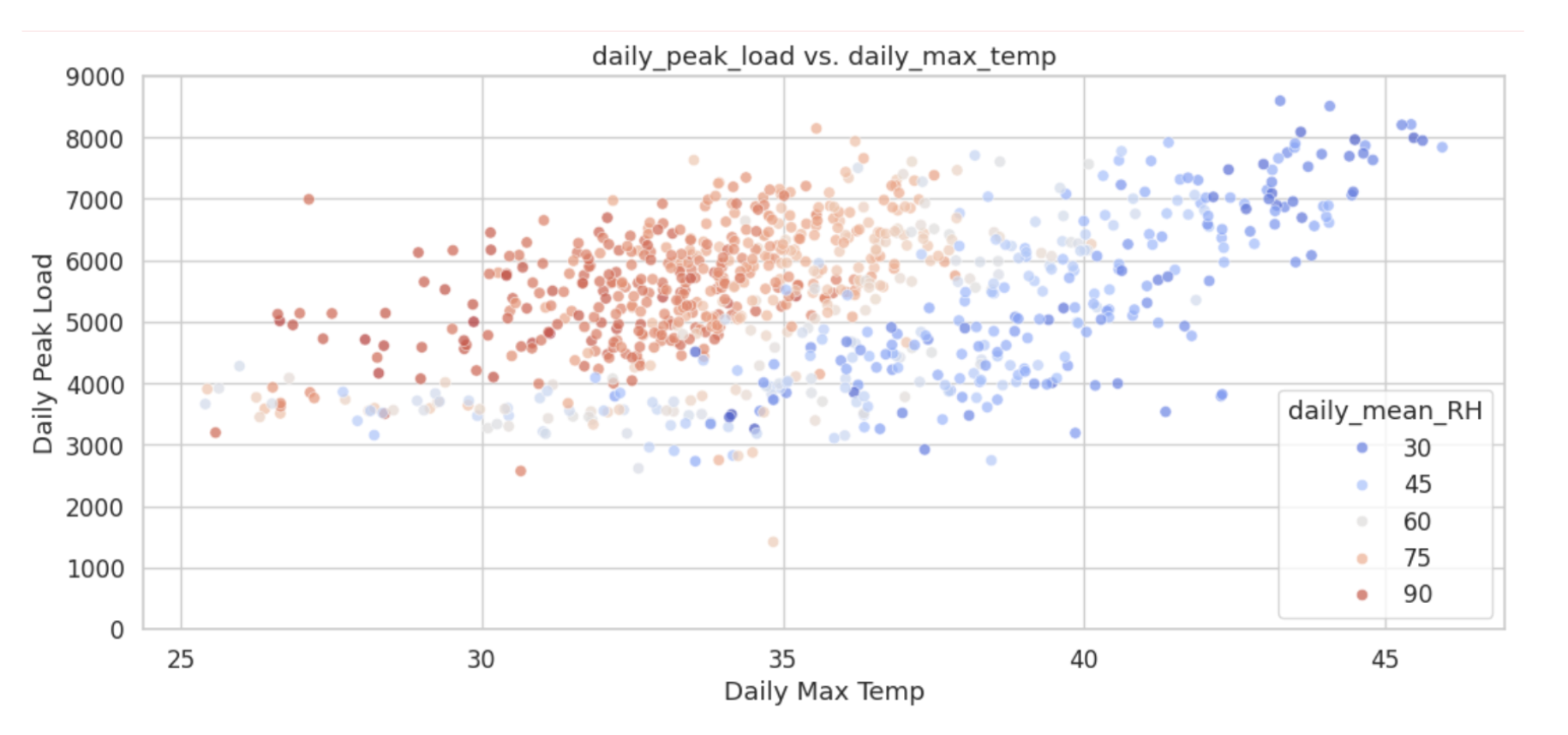
Figure 1 illustrates the variation in daily peak electricity demand (in MW) in Delhi with daily maximum temperatures and average relative humidity between March and September over the last five years. As expected, daily peak electricity demand rises linearly with increasing daily maximum temperatures. Interestingly, demand remains elevated even on days with moderately high temperatures (30–35°C) and high humidity levels (75–90 per cent). This is because humidity worsens thermal discomfort by limiting the body’s ability to cool itself through sweating. As a result, even at moderate temperatures, we feel the need to use ACs for both cooling and dehumidification. The combined effect of temperature and humidity is particularly relevant in the context of Delhi’s shifting monsoon patterns. For instance, the average relative humidity (RH) from 1 June–18 August 2025 was the second highest in 53 years, leading to persistent stifling conditions and sustained cooling demand, even in the absence of extreme heat.
Figure 1: Delhi’s peak power demand rises in line with temperature (Mar–Sept 2020–24)
Source: Authors’ analysis based on demand data from the MERIT Portal and temperature and relative humidity data from CRAVIS.
How do warm nights put greater pressure on power demand?
Night-time conditions provide critical insight into Delhi’s surging power demand. Using daily minimum temperatures as a proxy for night-time temperatures, Figure 2 shows that the city’s peak power load is more strongly correlated with night-time temperatures than with day-time maximum temperatures (Figure 1). The correlation suggests that Delhi’s power demand is more heavily influenced by warmer nights than hotter days. These unusually warm nights in urban areas are caused by the heat island effect i.e., heat released by hard and dark surfaces that is stored during the daytime, such as roads, dark rooftops, and concrete surfaces. Besides this, night-time also sees increased AC usage due to consumers returning home from work and prioritising thermal comfort while sleeping. This is entirely powered by the electricity grid, since rooftop solar plans cannot offset night-time consumption without battery storage. Even though the Delhi Solar Energy Policy 2023 envisages installing 750 MW of rooftop solar capacity by 2026–27 to supplement grid capacity, meeting night-time electricity demand will continue to pose a significant challenge for grid operators.
What do long-term climate projections predict?
Using the CRAVIS Atlas, we can visualise the long-term climatic trends for temperature and extreme heat events in Delhi. The city has already witnessed a slight increase in the number of hot days per year, those with daily maximum temperature above 35°C, from 120 days during 1981–2010 to 123 days in 2011–2024. As shown before (Figure 1), 35°C marks the threshold beyond which cooling demand and electricity consumption increase sharply.
Model-based projections suggest the heat stress will intensify significantly in the coming decades. Between 2031–2050, Delhi is projected to experience a 40 per cent increase in the number of days with maximum temperature exceeding 35°C, about 173 days a year, or nearly six months. By 2051–2070, this number will climb to 198 days, a 60 per cent increase compared to the 123 days of 2011–2024. Figure 4 provides a district-level visualisation of this projected increase in the number of days with daily maximum temperatures above 35°C.
Figure 4: Comparative view of the number of days per year with daily maximum temperature greater than 35°C in 2011–2024 and future projections for 2031–2050.
Source: Visualisation from the Climate Resilience Atlas.
A similar warming trend is projected for night-time temperatures, albeit with a comparatively smaller percentage increase. On average, Delhi recorded 177 days per year with minimum temperatures above 20°C during 1981–2010, which has risen slightly to 180 days per year in 2011–2024. Model-based projections suggest that this number will increase to 195 days per year in 2031–2050, and further to 213 days per year between 2051–2070 .
Figure 5 depicts a district-level comparison of the projected number of days per year with daily minimum temperatures exceeding 20°C. As established earlier, higher frequency of unusually warm nights will lead to sustained periods of elevated cooling demand and increased electricity consumption.
Figure 5: Comparative view of the number of days per year with daily minimum temperature above 20°C between 2011–2024 and future projections for 2031–2050.
Source: Visualisation from the Climate Resilience Atlas.
Why is managing high peak demand a persistent challenge?
1. High cost of electricity during peak demand hours
The price of electricity in the open bulk market, where discoms often purchase additional power to meet unpredictable demand, varies by the time of day. When solar energy is abundant during daylight hours, electricity prices are relatively low. But, as solar generation declines in the evening, supply becomes relatively scarce, and prices shoot up. Since retail tariffs stay flat, discoms suffer a financial strain on their operations.
2. Risk of infrastructure stress and outages
If distribution infrastructure, such as transformers, cables, and substations, is not adequately sized to handle maximum electricity loads, it can overheat and fail. This raises the probability of localised blackouts during periods of high demand, especially in dense residential neighbourhoods where the use of cooling appliances is concentrated. In Delhi, which is already characterised by a high-density built environment and limited spare space for grid expansion, this risk is particularly acute.
3. High costs from underutilised infrastructure
It is obvious that Delhi’s electricity infrastructure must expand to keep pace with rising demand. However, the challenge lies in the fact that the demand spikes to extreme levels only for a few hours or days each summer. Designing the grid to serve these short-lived spikes would mean building extra capacity that remains underutilised for the remaining year. Since the cost of infrastructure upgrades is recovered through electricity tariffs, consumers would ultimately bear the cost of idle infrastructure.
How can we meet rising power demand during extreme heat?
Managing climate change-driven surges in electricity demand will require a diverse mix of adaptation and mitigation strategies to strengthen the electricity system against extreme heat.
1. Make energy-efficient cooling appliances the default and adopt energy-saving behaviours. The Bureau of Energy Efficiency (BEE) estimated that India saved 5.6 per cent by improving the efficiency of appliances. However, the benefits of efficiency are contingent as much on maintenance and use as on technology. For example, an irregularly serviced 5-star AC may likely perform similarly to a 3-star AC, while raising the AC set point by just 1°C can reduce energy consumption by about six per cent.
Next-generation ACs must be scaled up for better temperature and humidity management. Existing ACs over-cool the air, removing moisture and consuming extra energy. Delhi provides an ideal testing ground for alternatives, like evaporative cooling for dry heat and desiccant-based dehumidification, which can be later scaled up based on their impact.
2. Scale up climate-responsive designs and materials for passive cooling of buildings. Design interventions, such as cool roofs andheat-reflectivecoatings, help delay or reduce reliance on energy-intensive cooling appliances. Applying reflective coatings, like light-coloured cement, paint or tiles, to exposed rooftops can lower indoor temperatures by up to 2°C. While Delhi’s Heat Action Plan recognises “cool roofs” as a long-term heat mitigation measure, it should be supplemented with clear targets and mandates, similar to the Telangana Cool Roof Policy 2023.
3. Use demand response and time-of-day tariffs to shift consumption from peak hours. Despite demand-side measures, Delhi’s energy consumption will continue to grow, making it essential to upgrade the city’s power supply infrastructure. Smart electricity metres provide a wealth of previously inaccessible information on energy use patterns. These can be used to enable more accurate demand forecasting, and cost-effective energy procurement and supply infrastructure planning. Pilot initiatives in Delhi using smart meters and smart plugs have shown that demand response i.e., voluntary or automatic appliance management, can help consumers cut their peak load by ~15 per cent. While time-of-day (ToD) tariffs already charge 20 per centmore during peak hours (2–5pm and 10pm–1am in May–September), demand response programmes offer incentives for reducing consumption during certain critical hours. The Delhi government must work with discoms and the Delhi Electricity Regulatory Commission to mainstream these programmes as part of a comprehensive heatwave strategy.
4. Expand clean energy generation paired with storage to meet rising demand without increasing carbon emissions. CEEW’s analysis shows that clean energy paired with storage offers a reliable pathway to meet higher-than-expected demand in 2030. State and Central government agencies must resolve land, supply chain and connectivity challenges that currently constrain clean energy growth.
While Delhi’s socio-economic profile may make it an outlier among Indian states, the potential impact of unpredictable weather on power systems is reminiscent of many urban cities in India. Smarter appliance choices and usage, coupled with a well-planned built environment and electricity system, will help maintain high standards of power reliability as heat stress intensifies in the years ahead.
Mirambika Sikdar is Research Associate, Yashi Gupta is Associate Product Manager, and Dhruvak Aggarwal and Pushp Bajaj are Programme Leads at the Council on Energy, Environment and Water (CEEW). Send your comments to yashi.gupta@ceew.in.